
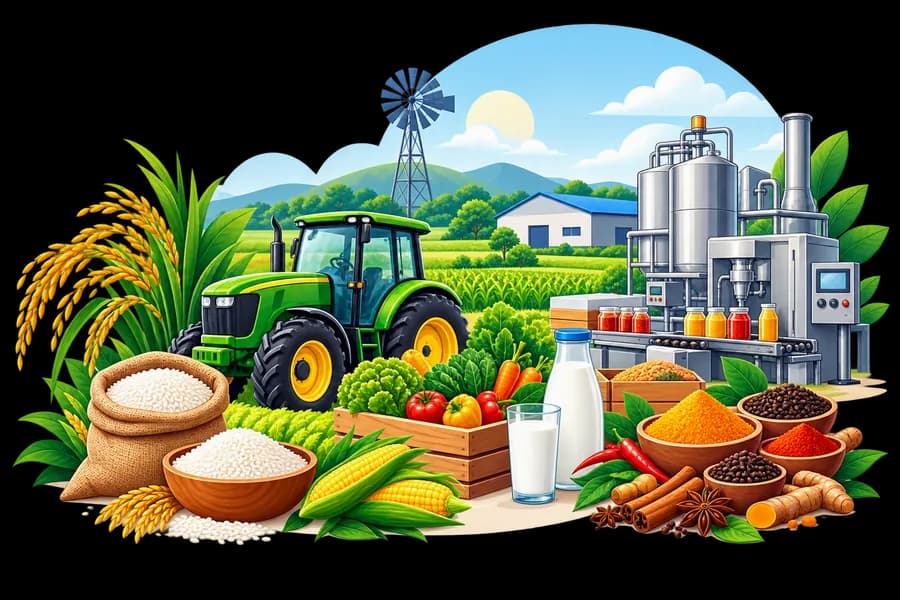
Agro and Food Processing
₹15 lakh – ₹2 crore (typical)
Food processing is the highest-volume DPR sector in Odisha, and the numbers behind that are real: India's food processing market reached roughly ₹30.5 lakh crore in 2024, growing at 6.55% a year — faster than manufacturing overall — and it's India's largest employer within organised manufacturing. In Odisha specifically, 240 micro food-processing units have been sanctioned credit-linked subsidy under PMFME's district-product programme alone. The activities below are what we actually see coming through the door.
Applicable subsidy route
Route to the Food Processing Policy 2022 (30–35% Capital Investment Subsidy, cap ₹3.5cr/₹4cr) rather than the MSME Policy — it pays more at every level for a genuine food-processing activity. PMFME adds a 35% credit-linked subsidy up to ₹10 lakh for individual micro units.
Negative-list position
Highest-scrutiny sector on the negative list — rice/flour/oil milling, confectionery, betel-nut and several other food activities carry specific thresholds or exclusions. Screen the exact activity before quoting.
What counts as agro and food processing
Cashew kernel processing
Odisha is one of India's major cashew-growing states. Not on the negative list — a straightforward Food Processing Policy 2022 claim.
Dairy processing
From small pasteurising/chilling units to full market-milk plants. Seven Odisha districts (including Cuttack, Puri, Bolangir) are PMFME milk-ODOP districts.
Fruit & vegetable processing
Canned pulp, pickle, jam and jelly. Strong fit for mango (Angul, Subarnapur), pineapple (Gajapati) and other ODOP districts.
Spice processing & grinding
Turmeric, chilli, ginger — five Odisha districts are PMFME spice-ODOP districts. Sits in the lighter Green pollution category regardless of scale.
Millet processing
Aligned with the Odisha Millets Mission and PMFME's Malkangiri/Nuapada millet-ODOP designation. No formal NABARD model project exists yet for this activity — costing is more indicative than the others below.
Rice, flour & edible oil milling
Heavily restricted — see the negative-list note above. Rice mills need ₹10cr+ investment, flour mills ₹1cr+, and oil mills are excluded outright with no threshold that cures it.
Licenses and registrations you'll need
FSSAI registration or license
Thresholds changed materially in 2026: Basic Registration now covers turnover up to ₹1.5 crore (raised from the old ₹12 lakh, effective 1 April 2026), State License covers ₹1.5cr–₹50cr, and Central License applies above ₹50cr (or for importers/exporters). Registrations are now perpetually valid subject to risk-based inspection, replacing the old 1–5 year renewal cycle. Older capacity-based triggers (e.g. dairy above 50,000 litres/day needing a Central License regardless of turnover) may still apply alongside the new turnover rule — unconfirmed post-2026, check with FoSCoS or your local FSSAI office.
Pollution control consent (OSPCB)
Most processing activities — cashew, dairy, bakery/confectionery above 1 tonne/day, fish processing, vegetable oil — sit in the Orange category, needing Consent to Establish before construction and Consent to Operate before running. Dal mills, rice hullers, spice grinding (any scale) and flour mills sit in the lighter Green category. Note: Odisha's published list may not yet reflect CPCB's January 2025 national move to a five-category system (adding 'Blue') — confirm your activity's current category with OSPCB directly.
Udyam / MSME registration
Free, lifetime-valid, and the basis for every subsidy and priority-sector-lending claim that follows.
Entity not registered yet? See business registration and how DIC approval works.
Typical machinery and investment
Rough, indicative ranges for a small-to-medium unit — every project's actual cost depends on capacity, automation level and supplier quotations.
| Activity | Investment range | Key machinery |
|---|---|---|
| Cashew kernel processing (500 MT/year) | ₹1.59 crore (NABARD model) | Steam boiler, semi-automated peeling machine, colour sorting machine, hot-oven dryer |
| Dairy processing (10,000 litres/day) | ₹2.58 crore (NABARD model) | Cream separator, chiller, pasteuriser, ghee boiler, CIP unit, pouch packing line |
| Fruit & vegetable processing (300 MT/year) | ₹74.78 lakh (NABARD model) | Washing machine, sorting conveyor, twin pulper, steam-jacketed kettles, canning line |
| Spice processing & grinding | ₹12 lakh – ₹1.1 crore (indicative, by scale) | Cleaning/grading unit, pulveriser, disintegrator, sieving unit, pouch filler-sealer |
| Millet processing | ₹2 lakh – ₹70 lakh (indicative, by scale) | Destoner, grader/aspirator, dehuller, pulveriser, flaking/pop machine |
A worked example: fruit & vegetable processing
NABARD's own model for a 300 MT/year canned-pulp, pickle and jam unit costs about ₹74.78 lakh all-in, of which ₹40.23 lakh is plant & machinery. Routed correctly to the Food Processing Policy 2022 rather than the MSME Policy, that P&M figure earns a Capital Investment Subsidy of ₹12.07 lakh at the general rate (30%) or ₹14.08 lakh at the reserved-category rate (35%) — before any backward-district top-up or PMFME layering. Use our eligibility checker with your own numbers for a project-specific figure.
Frequently asked questions
What FSSAI license does a food processing unit in Odisha need?+
It depends on turnover, since 2026 rules: Basic Registration up to ₹1.5 crore turnover, a State License from ₹1.5cr to ₹50cr, and a Central License above ₹50cr. Some capacity-based triggers from the older rules (large dairy or meat units, for instance) may still apply on top of the turnover test — confirm with FoSCoS or your local FSSAI office for edge cases.
Is a cashew processing project eligible for Capital Investment Subsidy in Odisha?+
Yes — cashew kernel processing is not on Odisha's negative list, and as a food-processing activity it should be routed to the Food Processing Policy 2022 (30–35% CIS) rather than the general MSME Policy, which pays less at every investment level for this activity.
What is PMFME's ODOP and which product is my district assigned?+
One District One Product (ODOP) is PMFME's way of clustering support around each district's dominant food product — for example milk in Cuttack and Puri, mango in Angul and Subarnapur, turmeric in Kandhamal, millet in Malkangiri and Nuapada. Note that Odisha separately runs its own, different ODOP scheme for handicrafts and other exports (run by the Directorate of Export Promotion & Marketing) — don't confuse the two; a district's handicraft ODOP and its PMFME food ODOP are often different products entirely.
Do I need pollution control clearance for a food processing unit?+
Usually yes. Cashew processing, dairy, bakery/confectionery above 1 tonne/day, fish processing and vegetable oil units fall in the Orange category and need Consent to Establish before construction and Consent to Operate before running. Dal mills, rice hullers, spice grinding and flour mills sit in the lighter Green category. Confirm your specific activity's current category with the Odisha State Pollution Control Board.
Where is Odisha's Mega Food Park?+
MITS Mega Food Park is in Rayagada district, not Khordha — a common mix-up, likely because the park's network includes a Primary Processing Centre located in Khordha alongside others at Kashipur, Padampur, Umerkote, Koraput and Digapahandi. The main park itself, with its Central Processing Centre, rice processing complex and cold storage, is in Rayagada.
How much does a small food processing unit actually cost to set up?+
Based on NABARD's own model project reports: a 300 MT/year fruit & vegetable processing unit runs about ₹75 lakh, a 500 MT/year cashew processing unit about ₹1.6 crore, and a 10,000 litre/day dairy plant about ₹2.6 crore. Spice grinding and millet processing scale down much further — from roughly ₹2–12 lakh for the smallest setups.
Sources: FSSAI Reforms press release, fssai.gov.in (13 Mar 2026) · MoFPI ODOP list for 713 districts, mofpi.gov.in · PIB — MITS Mega Food Park, Rayagada · NABARD Model Project Reports (cashew, dairy, fruit & vegetable), agritech.tnau.ac.in · Odisha State Pollution Control Board category lists, ospcboard.odisha.gov.in · IBEF Food Processing Industry Report; PIB PMFME statistics
Get an indicative subsidy figure for a project in this sector, checked against the negative list and Odisha's district classification.
Check eligibility