
Cashew Processing
₹40 lakh – ₹2 crore (typical, by scale)
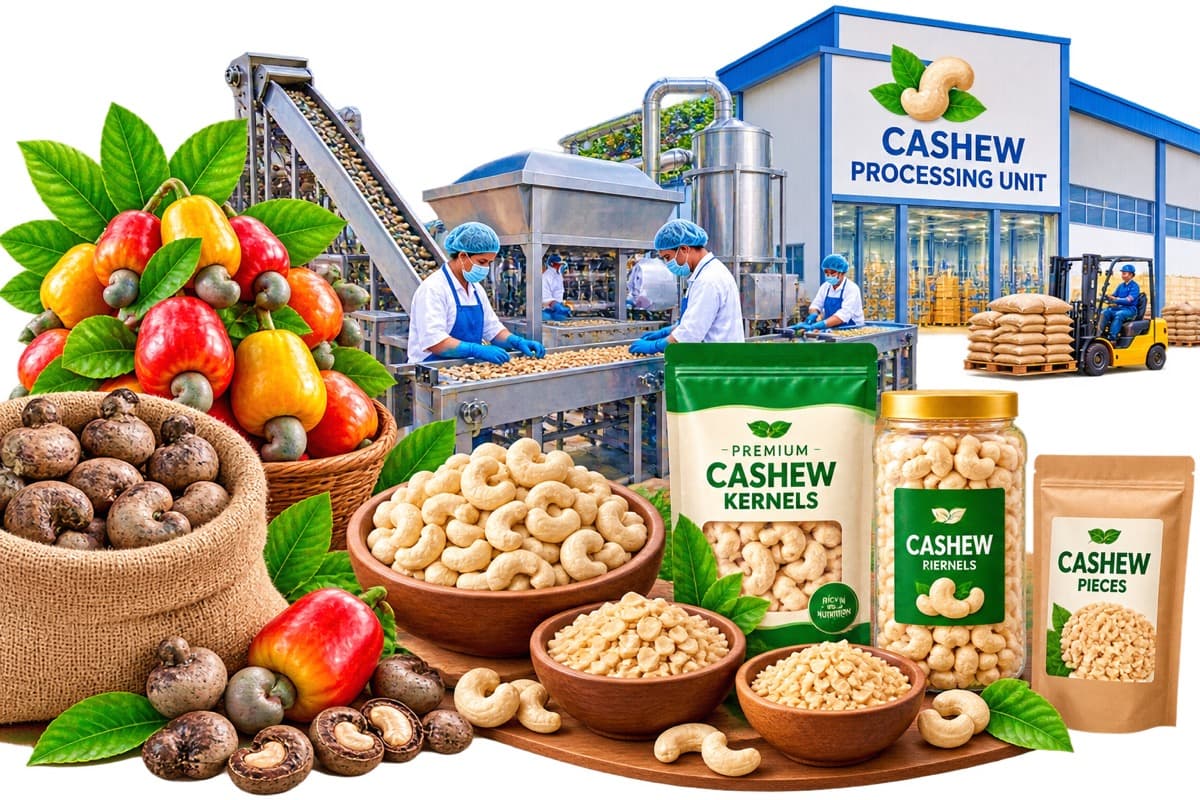
Ganjam is one of India's established cashew belts, and Odisha runs its own institutional infrastructure for the crop through the Odisha State Cashew Development Corporation (OSCDC) — but it's worth being precise about what that institution actually does before relying on it: OSCDC runs 19 nurseries and plantation-development programmes to secure raw cashew supply, not a processing-subsidy or financing scheme. The processing-side subsidy stack for a cashew unit is the general state Food Processing Policy 2022, plus — if the unit exports, or plans to — a genuinely valuable, cashew-specific central scheme most DPRs never check: the Cashew Export Promotion Council of India's (CEPCI) mechanisation and automation subsidy, layered on top of the state's capital subsidy.
Cashew Processing isn't in our instant self-service catalogue yet — tell us your project basics and we'll prepare it as an Assisted DPR instead, usually within 3 working days.
Start your requestApplicable subsidy route
Not on the negative list — a straightforward Food Processing Policy 2022 claim (30–35% CIS, cap ₹3.5–4cr; 30% cap ₹5cr for an Anchor Industry-scale project). A second, cashew-specific lever most DPRs miss: the central Cashew Export Promotion Council's mechanisation subsidy for member exporters — a different cost line, and combinable with the state subsidy.
Negative-list position
Not excluded.
What counts as cashew processing
Raw cashew nut (RCN) shelling & processing
The core activity — steaming/roasting, shelling, peeling and grading raw cashew into kernels. The NABARD model project (500 MT/year, ₹1.59 crore) referenced in our Agro & Food Processing guide is built around this activity.
Kernel grading & packing
Sorting kernels into export/retail grades (whole, splits, pieces) and packing — often integrated into the same unit as shelling rather than run separately.
Roasted & flavoured cashew (value-added)
Salted, roasted and flavoured cashew for direct retail sale — a materially higher price realisation than plain kernel, but a distinct product line with its own packaging and shelf-life requirements.
Cashew Shell Liquid (CNSL) extraction
A by-product processing line extracting oil from the cashew shell waste for industrial use (resins, brake linings) — an add-on revenue stream for a larger unit, not typically viable standalone at small scale.
Licenses and registrations you'll need
Udyam / MSME registration
Free, lifetime-valid, and the basis for the Food Processing Policy 2022 claim alongside PAN and GSTIN.
FSSAI registration or license
Same 2026 turnover thresholds as other food processing: Basic up to ₹1.5cr turnover, State ₹1.5cr–₹50cr, Central above ₹50cr.
CEPCI membership / Registration-cum-Membership Certificate (RCMC)
Needed to export cashew, and the specific membership that unlocks CEPCI's mechanisation subsidy described in the worked example below. Not required for a purely domestic-market unit.
Pollution control consent (OSPCB)
Cashew processing (steaming/roasting) typically falls in the Orange category, mainly for the steaming/effluent aspect of shelling — confirm the specific category for your process with OSPCB before finalising the site.
Entity not registered yet? See business registration and how DIC approval works.
Typical machinery and investment
Rough, indicative ranges for a small-to-medium unit — every project's actual cost depends on capacity, automation level and supplier quotations.
| Activity | Investment range | Key machinery |
|---|---|---|
| Cashew processing (500 MT/year — NABARD model) | ₹1.59 crore (NABARD model) | Steaming/roasting unit, shelling machines, peeling machines, grading and sorting equipment, packing line |
| Small manual/semi-mechanised shelling unit | ₹40 lakh – ₹80 lakh (indicative — labour-intensive, lower automation) | Basic steaming unit, hand-shelling tools or semi-automatic shellers, drying racks, basic packing |
| Roasted & flavoured cashew line (value-add, on top of a base shelling unit) | ₹15 lakh – ₹40 lakh (indicative, additive to a base unit) | Roasting/frying equipment, flavour-coating drum, retail packing/sealing machine |
A worked example: stacking the state CIS with CEPCI's mechanisation subsidy
The NABARD reference project — a 500 MT/year cashew processing unit at ₹1.59 crore — earns a Food Processing Policy 2022 Capital Investment Subsidy of 30% (general) or 35% (reserved category) on plant & machinery, capped at ₹3.5–4 crore, well above what a unit this size would need. Separately, if the promoter registers with CEPCI as a member exporter, the same or a follow-on investment in mechanising and automating the processing line is separately eligible for a CEPCI subsidy of 33.33% of eligible investment, capped at ₹1 crore (₹100 lakh) — plus up to ₹5 lakh for food-safety/quality certification. The two apply to different institutional relationships (state DIC/IPICOL vs. central CEPCI) and, in principle, different cost heads (initial plant & machinery vs. later mechanisation/automation upgrades), so a growing cashew unit can realistically draw on both across its life — though, as with any subsidy stack, the bank or DIC will confirm the exact cost items claimed don't overlap between the two.
Frequently asked questions
What subsidy applies to a cashew processing unit in Odisha?+
The state's Food Processing Policy 2022 Capital Investment Subsidy — 30% (general) or 35% (reserved category) of plant & machinery cost, capped at ₹3.5–4 crore, or 30% capped at ₹5 crore for a larger, Anchor Industry-scale project. Cashew has no separately higher state rate — that's a common misconception.
Does OSCDC provide loans or subsidies to cashew processing units?+
No. The Odisha State Cashew Development Corporation runs plantation and nursery development to secure raw cashew supply — it is not a financing or subsidy body for processing units. Don't confuse it with a processing-subsidy scheme.
What is the CEPCI subsidy, and who can claim it?+
The Cashew Export Promotion Council of India offers member exporters a subsidy of 33.33% of eligible investment (capped at ₹1 crore) for mechanising and automating a cashew processing unit, plus up to ₹5 lakh for quality/food-safety certification. It requires CEPCI membership (RCMC), so it's aimed at units that export or plan to — a purely domestic-market unit wouldn't qualify under this specific scheme.
Can I claim both the state subsidy and the CEPCI subsidy on the same project?+
Potentially yes, since they're administered by different bodies (state DIC/IPICOL vs. central CEPCI) and typically apply to different cost heads — the initial plant & machinery cost versus a later mechanisation/automation upgrade. The bank or DIC handling your file will confirm the specific cost items claimed under each don't overlap, which is a standard 'no double subsidy on the same expenditure' condition across schemes.
How much does a small cashew processing unit cost?+
NABARD's own reference model — a 500 MT/year unit — costs about ₹1.59 crore. A smaller, more manual/semi-mechanised shelling unit can start around ₹40–80 lakh, with a roasted/flavoured cashew retail line adding roughly ₹15–40 lakh on top of a base unit.
Sources: Odisha State Cashew Development Corporation (OSCDC) — oscdc.nic.in · Cashew Export Promotion Council of India (CEPCI) — cashewindia.org, assistance-to-members scheme details · NABARD Model Project Report — Cashew Processing (500 MT/year), agritech.tnau.ac.in (also the basis for our own Agro & Food Processing guide's cost table) · Odisha Food Processing Policy 2022, investodisha.gov.in
Get an indicative subsidy figure for a project in this sector, checked against the negative list and Odisha's district classification.
Check eligibility