
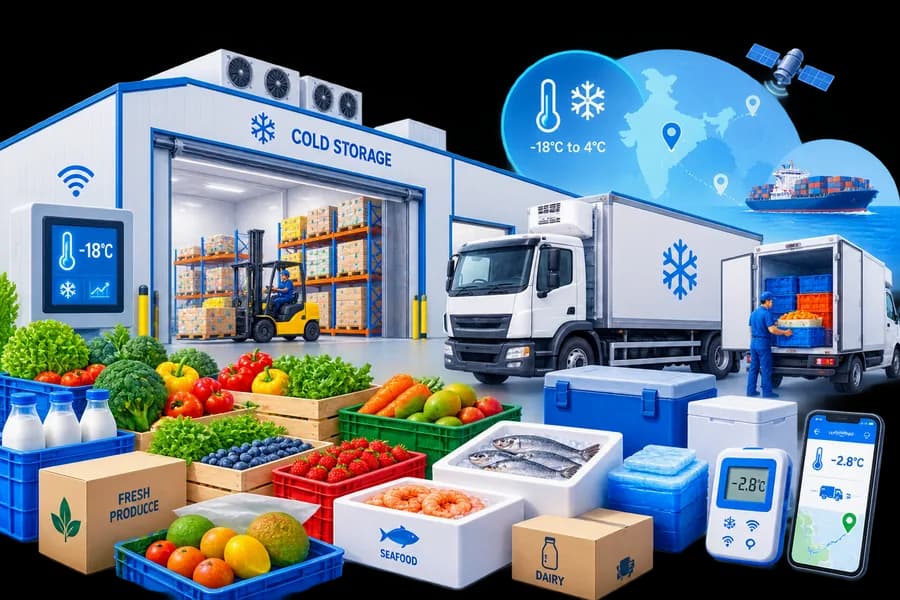
Cold Storage and Cold Chain
₹50 lakh – ₹5 crore (typical)
Cold chain is one of the few sectors where Odisha's own government has publicly admitted the gap: the state's 2025 cold-storage scheme document maps districts with no cold storage at all, alongside existing units marked functional versus defunct — a coverage problem and a maintenance problem, both documented, not assumed. That gap has a real cost: Odisha's Potato Mission largely stalled on the lack of adequate cold storage and market linkage, and Bargarh farmers have dumped truckloads of vegetables on the highway when prices crashed with nowhere to store the surplus. The state's response, launched by the Chief Minister in July 2024 and notified in early 2025, is a dedicated capital subsidy scheme — separate from the general MSME and Food Processing policies — aiming for a cold storage in every sub-division by 2030.
Applicable subsidy route
Three routes exist, and picking the wrong one leaves real money on the table: the general MSME Policy 2022 (25–30% CIS, cap ₹2–2.5cr) as a named service-sector exception from ₹25 lakh; the Food Processing Policy 2022 (35% CIS up to ₹5cr plus a power tariff subsidy) for cold-chain/preservation infrastructure; and Odisha's dedicated 2025 cold-storage scheme (50–60% CIS, cap ₹6–6.5cr) run by APICOL, which is now the richest of the three for a standalone project.
Negative-list position
Not on the negative list — actively encouraged. Named as a growth-potential sector in the MSME Policy 2022 and eligible as a service-sector exception from ₹25 lakh; the state's 2025 scheme goes further, targeting at least one cold storage in every one of Odisha's 58 sub-divisions.
What counts as cold storage and cold chain
Bulk / multi-commodity cold storage
The dominant standalone project type in Odisha — potato and vegetable focused, and the specific target of the state's 2025 scheme. Nationally, potato storage alone accounts for the bulk of India's installed cold storage capacity.
Ice plants and chilling plants
The natural fit for Odisha's coastal fishery belt (Ganjam, Puri and similar districts) — feeds fisheries, food processing and local retail. OSPCB's base classification treats non-ammonia chilling/ice-making plants as Green category; see the licensing note below on why ammonia-based plants are a different question.
Reefer / insulated transport
Usually costed as a line item inside a larger DPR rather than a standalone project. The state scheme explicitly defers to MIDH/PMMSY/NABARD/APICOL norms for refrigerated-van costing rather than open-market vehicle price.
Ripening chambers
Small-footprint, standardised units (commonly banana or mango) costed at roughly ₹1 lakh per MT capacity in reference model reports. Not separately incentivised by an Odisha-specific scheme as of this research — it draws on the same three subsidy routes as bulk storage.
Controlled-atmosphere (CA) storage
Regulates oxygen, CO₂ and nitrogen levels alongside temperature to extend shelf life further than plain cold storage. Industry sources describe it as requiring validated processes and long-term buyer tie-ups — a second-project step-up, not usually a first DPR.
Revival of sick / defunct cold storages
Explicitly covered by the 2025 state scheme — case-by-case assistance up to ₹1.5 crore toward arrear electricity, tax and bank dues for existing units that have gone non-functional, not just new construction.
Licenses and registrations you'll need
Pollution control consent (OSPCB) — refrigerant matters
CPCB's base industrial classification lists 'chilling plant, cold storage and ice making' as Green category only where cooling is by water recirculation, and separately clears ice-making 'without using ammonia' as Green. It does not contain an explicit Green entry for ammonia-based refrigeration — the standard choice for most sizeable Indian cold storages — and isolated storage of hazardous chemicals above threshold quantities is itself Red category. In practice this means a typical ammonia-refrigerated bulk cold storage may not automatically get the lighter Green treatment; OSPCB decides sectors that don't clearly fit a category case-by-case. Confirm your plant's category directly with OSPCB before assuming Green.
FSSAI license (if storing food)
Capacity-based, not turnover-based, for storage: a State License covers cold/refrigerated storage up to 10,000 MT and CA-plus-cold storage up to 1,000 MT, with a Central License required above those thresholds. Almost every small-to-medium standalone Odisha cold storage (typically 500–5,000 MT) needs only a State License. A purely industrial or pharma cold room handling no food may not need FSSAI at all.
Factory licence (Factories Act 1948)
Applies once a unit has 10+ workers using power or 20+ without — the same Odisha threshold as other manufacturing sectors. Most standalone cold storages, which run on a small loading/monitoring staff, often sit below this; a unit with an attached processing or packing line is more likely to cross it.
Electrical Inspectorate approval (HT connection)
Cold storages are power-intensive and commonly need a High Tension connection, which requires the Chief Electrical Inspector's drawing approval before erection and inspection/energisation approval after completion. Confirm the exact form and turnaround with Odisha's Electrical Inspectorate under the Energy Department before costing your timeline.
Legal Metrology (weighbridge verification)
Not a cold-storage-specific licence, but relevant because most cold storages run a weighbridge for incoming/outgoing produce — any weighing instrument used commercially needs verification and stamping under the Legal Metrology (General) Rules, 2011, via the district Legal Metrology Inspector.
WDRA registration (optional)
Not required to operate a cold storage. It matters only if the operator wants to issue Negotiable Warehouse Receipts, letting farmer-clients pledge stored produce for bank loans — WDRA has notified 24 horticultural commodities eligible for this from registered cold storages. Worth pitching as a value-add, not a compliance requirement.
Udyam / MSME registration
Free, lifetime-valid, and a standard document requirement across all three subsidy routes above, alongside GSTIN, PAN and land records.
Entity not registered yet? See business registration and how DIC approval works.
Typical machinery and investment
Rough, indicative ranges for a small-to-medium unit — every project's actual cost depends on capacity, automation level and supplier quotations.
| Activity | Investment range | Key machinery |
|---|---|---|
| Bulk / multi-commodity cold storage (1,000 MT — APICOL reference project) | ₹2.75 crore total project cost (dated cost structure; subsidy % below is now higher under the 2025 scheme) | Ammonia/refrigerant compressor units, insulated PUF panel cold rooms, condensers, evaporators, control panel, weighbridge |
| Multi-purpose cold storage (larger DC-MSME reference) | ≈ ₹8.64 crore total, of which ≈ ₹1.48 crore is plant & machinery (illustrative — capacity not specified in source) | Larger refrigeration plant, multiple insulated chambers, standby power, material-handling equipment |
| Ripening chamber (28 MT reference model) | ≈ ₹29.5 lakh total (≈ ₹1 lakh/MT norm) | Ripening chamber unit, ethylene gas system, temperature/humidity control, curtains and racks |
| Reefer van / insulated transport | ₹3 lakh – ₹95 lakh depending on payload and body type (open-market range — subsidy costing follows MIDH/PMMSY/NABARD/APICOL norms, not vehicle sticker price) | Insulated van body, refrigeration unit, temperature logger |
A worked example: 1,000 MT bulk cold storage
APICOL's own reference project for a 1,000 MT cold storage costs about ₹2.75 crore all-in. Under Odisha's 2025 Financial Assistance to Cold Storages scheme, a general-category promoter can claim a Capital Investment Subsidy of 50% of fixed capital expenditure (capped at ₹6 crore), and an SC/ST, Women or Transgender promoter 60% (capped at ₹6.5 crore) — either well above what the general MSME Policy's 25–30% CIS would pay on the same project. The same scheme adds up to 6% interest reimbursement on the term loan and a 50% electricity tariff subsidy for up to 7 years. Whether this state subsidy can be layered with the separate National Horticulture Board credit-linked subsidy (35–50%) on the same cost head isn't clearly confirmed in the public scheme documents — treat that as one figure to verify with APICOL before quoting a combined number to a client. Use our eligibility checker with your own numbers for a project-specific figure.
Frequently asked questions
What subsidy can a new cold storage get in Odisha?+
As of 2025, the richest route for a standalone cold storage is Odisha's dedicated Financial Assistance to Cold Storages scheme, run by APICOL: 50% of fixed capital cost (capped ₹6 crore) for general-category promoters, or 60% (capped ₹6.5 crore) for SC/ST, Women or Transgender promoters — well above the general MSME Policy's 25–30% or the Food Processing Policy's 35%. The scheme also reimburses up to 6% loan interest and half the electricity bill for up to 7 years.
Does an existing, non-functional cold storage qualify for help, or only new projects?+
The Capital Investment Subsidy itself applies only to new cold storages. But the 2025 state scheme separately covers reviving sick or defunct units — case-by-case assistance up to ₹1.5 crore toward arrear electricity, tax and bank dues — which matters given how many of Odisha's existing cold storages the scheme's own district mapping shows as non-functional.
What pollution clearance does a cold storage need in Odisha?+
It depends on the refrigerant. Non-ammonia chilling/ice-making plants using simple water recirculation are Green category under the base CPCB classification OSPCB follows. Most sizeable Indian cold storages use ammonia refrigeration instead, which isn't explicitly listed as Green — OSPCB decides sectors that don't clearly fit a category case-by-case, so confirm your plant's classification directly with the board before assuming the lighter Green route.
Do I need an FSSAI license for a cold storage?+
Only if you're storing food. If you are, it's capacity-based rather than turnover-based: a State License covers up to 10,000 MT of cold/refrigerated storage (or up to 1,000 MT if it's also controlled-atmosphere), which covers almost every small-to-medium Odisha project. A Central License is needed only above those thresholds.
How much does a small cold storage actually cost to build?+
APICOL's own reference project for a 1,000 MT bulk cold storage costs about ₹2.75 crore all-in. Smaller, standardised components scale down sharply — a 28 MT ripening chamber runs around ₹29.5 lakh, and an insulated/reefer transport van can start from a few lakh rupees depending on payload. Every project's actual cost still depends on capacity, refrigeration technology and civil-works quality.
Can I get both the state cold storage subsidy and a central scheme like NHB's?+
Odisha's 2025 scheme guideline says the state will leverage central schemes 'wherever possible,' and explicitly combines Centre and state interest reimbursement (3% AIF plus 3% state) — so some convergence is built in by design. Whether the state's capital subsidy and NHB's separate capital subsidy can both be claimed on the exact same cost head isn't spelled out in the public documents. Don't promise a stacked figure to a client without confirming it with APICOL first.
Sources: Government of Odisha, Dept. of Agriculture & Farmers' Empowerment — Operational Guidelines for Financial Assistance to Cold Storages, Notification dated 28.03.2025, agri.odisha.gov.in · Odisha MSME Development Policy 2022, msme.odisha.gov.in · APICOL reference project report — 1,000 MT Cold Storage, mkuy.apicol.nic.in · CPCB Final Document on Revised Classification of Industrial Sectors (Feb 2016), cpcb.gov.in · FOSCOS Kind of Business Eligibility schedule, foscos.fssai.gov.in · National Horticulture Board capital investment subsidy scheme, nhb.gov.in · WDRA FAQs on Negotiable Warehouse Receipts, wdra.gov.in · Press coverage: The Statesman, OMMCOM News, Orissa POST, ANI (Dec 2025) on the ₹252 crore state scheme outlay
Get an indicative subsidy figure for a project in this sector, checked against the negative list and Odisha's district classification.
Check eligibility