
Fishery and Marine Processing
₹25 lakh – ₹2 crore (typical)
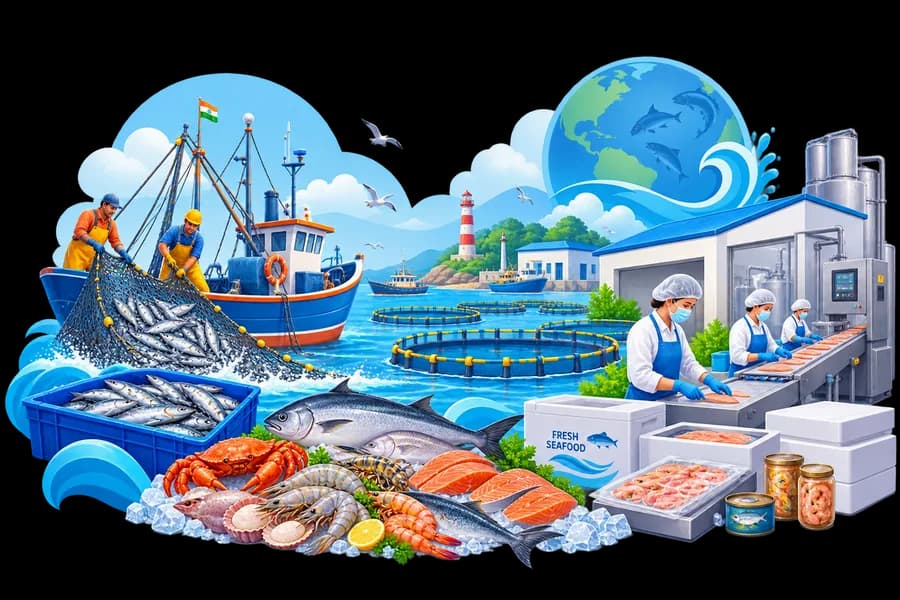
Odisha's coastline gives this sector a real, government-documented pipeline: the state has secured ₹1,301.18 crore of PMMSY-funded fisheries and aquaculture projects since the scheme launched in 2020-21, with the Centre contributing ₹484.64 crore of that. The Directorate of Fisheries, under the Fisheries & Animal Resources Development (F&ARD) Department, is the implementing agency on the ground. The one thing worth getting right before costing a DPR: PMMSY and the state's general food-processing subsidy are structured completely differently, and which one pays more depends on your specific project — not a fixed rule of thumb.
Fishery and Marine Processing isn't in our instant self-service catalogue yet — tell us your project basics and we'll prepare it as an Assisted DPR instead, usually within 3 working days.
Start your requestApplicable subsidy route
Two genuinely different subsidy routes exist for a processing unit — Pradhan Mantri Matsya Sampada Yojana (PMMSY), which pays 40% (general) or 60% (SC/ST/women) of an approved unit cost capped at ₹50 lakh, or the Food Processing Policy 2022's 30–35% Capital Investment Subsidy on plant & machinery. Which pays more depends on the project's cost structure — worked through below, not a fixed answer.
Negative-list position
Processing activities generally clear the negative list at the ₹25 lakh threshold. The MSME Policy's standard exclusion for 'hatcheries' appears written for livestock/poultry hatcheries (alongside piggeries, broiler and rabbit farming) rather than fish/shrimp hatcheries specifically — we could not independently confirm whether fish hatcheries fall inside or outside that exclusion, so treat farming/hatchery activities as a separate check from processing, not assumed clear.
What counts as fishery and marine processing
Marine fish & seafood freezing / processing
The core export-oriented activity for coastal districts (Ganjam, Puri, Balasore). Needs MPEDA registration only if the output is actually exported — see the licensing note below.
Value-added / ready-to-cook seafood products
Breaded, marinated or ready-to-cook seafood lines — a growing segment nationally, and where the equipment list gets materially longer (portioning, breading, blast-freezing) than plain freezing.
Dried & cured fish
The lowest-capital entry point in this sector — traditional sun-drying/salting needs little beyond drying platforms, racks and basic packaging.
Fish meal, fish oil & by-product processing
Converts processing waste/by-catch into feed-grade meal and oil — smaller volume, but a genuine value-add on an existing processing unit's waste stream.
Fish feed manufacturing
A separate PMMSY-funded infrastructure component (mini fish feed mills), often co-located with but distinct from a processing unit — cost it as its own line item, not folded into processing.
Fish farming, hatcheries & aquaculture
A different PMMSY vertical from processing, with its own component-wise subsidy norms. See the negative-list note above on the unresolved hatchery-exclusion question before assuming this is either clearly in or clearly out.
Licenses and registrations you'll need
Udyam / MSME registration
Free, lifetime-valid, and the basis for the state subsidy route (Food Processing Policy 2022) alongside PAN and GSTIN.
FSSAI registration or license
Same 2026 turnover-based thresholds as the rest of food processing: Basic Registration up to ₹1.5 crore turnover, State License ₹1.5cr–₹50cr, Central License above ₹50cr or for importers/exporters. A unit exporting seafood will likely need at least a State License regardless of turnover, given the export-linked capacity triggers that predate the 2026 reform — confirm the current interaction of the two rules with FoSCoS before relying on turnover alone.
MPEDA registration — only if exporting
Mandatory for any entity that processes, packs or exports marine products, but not required for a unit selling only into the domestic market. Needs an Import Export Code (IEC) as a prerequisite, and the certificate is valid for 3 years before renewal. Don't budget for this on a domestic-only DPR.
Coastal Regulation Zone (CRZ) clearance — site-dependent
The base position under the CRZ Notification 2019 lists new fish processing units as a restricted activity within the Coastal Regulation Zone, though certain related activities (hatcheries, traditional fish-drying) and case-by-case approvals exist depending on the CRZ category of the specific site. This only bites if the plot is actually within the notified CRZ boundary — most units sited a reasonable distance inland won't need it — but for a genuinely coastal plot, check with the state Coastal Zone Management Authority before finalising the site, not after.
Pollution control consent (OSPCB)
Fish/seafood processing effluent is typically high-BOD and organically loaded, which often places processing units in a stricter pollution category than dry food processing — we could not confirm the exact Orange/Red categorisation for Odisha specifically, so confirm directly with OSPCB before costing effluent treatment into the DPR.
Entity not registered yet? See business registration and how DIC approval works.
Typical machinery and investment
Rough, indicative ranges for a small-to-medium unit — every project's actual cost depends on capacity, automation level and supplier quotations.
| Activity | Investment range | Key machinery |
|---|---|---|
| Dried & cured fish (small unit) | ₹2 lakh – ₹10 lakh (indicative) | Drying racks/platforms, salting tanks, weighing scale, basic packaging equipment |
| Fish/seafood freezing unit | ₹50 lakh – ₹2 crore (indicative, scales with capacity — overlaps with the Cold Storage category's machinery) | Blast freezer, ice plant/flake-ice machine, cold storage room, grading and washing lines |
| Value-added / ready-to-cook seafood line | ₹75 lakh – ₹2.5 crore+ (indicative — no Odisha-specific model found) | Filleting/portioning line, breading/battering equipment, IQF tunnel freezer, vacuum packaging |
| Fish meal & fish oil plant | ₹30 lakh – ₹1.5 crore (indicative) | Cooker, screw press, rotary dryer, oil separation/clarification equipment |
A worked example: PMMSY vs. the Food Processing Policy — which pays more?
Take a seafood freezing unit costing ₹50 lakh — PMMSY's own reference unit cost for a fish value-added enterprise. Under PMMSY, a general-category applicant claims 40% of approved unit cost — ₹20 lakh — or 60% for SC/ST/women applicants — ₹30 lakh. Routed instead through the Food Processing Policy 2022, assuming roughly 70% of that ₹50 lakh (₹35 lakh) is plant & machinery, the Capital Investment Subsidy at 30% (general) or 35% (reserved category) works out to ₹10.5 lakh or ₹12.25 lakh. At this scale, PMMSY pays materially more, because it subsidises the whole approved unit cost rather than just the plant & machinery line. That gap narrows or reverses for a larger project once PMMSY's ₹50 lakh unit-cost cap starts to bind while the state policy's CIS keeps scaling with actual P&M investment. Use our eligibility checker with your own numbers before assuming either route.
Frequently asked questions
Do I need MPEDA registration to run a fish processing unit in Odisha?+
Only if you're exporting. MPEDA registration is mandatory for any entity that processes, packs or exports marine products for export, and needs an Import Export Code as a prerequisite — but a unit selling only into the domestic market doesn't need it.
Can I build a fish processing plant right on the coast?+
It depends on whether the plot falls inside the notified Coastal Regulation Zone. The base rule under the CRZ Notification 2019 restricts new fish processing units within the CRZ, though some related activities and case-by-case approvals exist depending on the zone category. Most inland-sited units never encounter this; a genuinely coastal plot needs a check with the Coastal Zone Management Authority before the site is finalised.
Is fish farming eligible for the same subsidy as fish processing?+
No — PMMSY treats farming/aquaculture and processing as separate components with their own subsidy norms, and the general MSME negative list's hatchery exclusion (written primarily for livestock/poultry) creates an unresolved question for fish hatcheries specifically. Cost farming and processing as two different eligibility questions, not one.
Which pays more for a fish processing unit — PMMSY or the state Food Processing Policy?+
It depends on project size. PMMSY subsidises 40% (general) or 60% (SC/ST/women) of the whole approved unit cost, capped at ₹50 lakh per unit — which can pay more than the state's 30–35% Capital Investment Subsidy (which applies only to the plant & machinery portion) for a smaller project. Once a project's plant & machinery investment grows large enough, the state route's higher, uncapped-by-unit-cost structure can overtake PMMSY's fixed ₹50 lakh ceiling. Run both numbers before choosing.
What licenses does a small dried-fish unit actually need?+
Less than you'd expect — Udyam registration and an FSSAI Basic Registration (for turnover up to ₹1.5 crore) cover most small dried/cured fish operations, since the equipment is simple (drying racks, salting tanks) and MPEDA/CRZ concerns only apply to exporters and coastal-sited plants respectively.
Sources: PMMSY Operational Guidelines, National Fisheries Development Board — nfdb.gov.in (component-wise subsidy norms referenced via Haryana Fisheries Department's published summary, harfish.gov.in, since the primary PDF could not be directly retrieved) · Fisheries & Animal Resources Development Department / Directorate of Fisheries, Government of Odisha — fard.odisha.gov.in, fisheries.odisha.gov.in · PMMSY Odisha project figures (₹1,301.18cr since 2020-21) — Kalinga TV, Odisha Diary press coverage · MPEDA registration requirements — compliance-service summaries (Agile Regulatory, PSR Compliance); confirm current fees/process directly with mpeda.gov.in · Coastal Regulation Zone Notification 2019 (with 2021–2022 amendments) — via secondary legal summaries; confirm site-specific applicability with the state Coastal Zone Management Authority · Odisha Food Processing Policy 2022, msme.odisha.gov.in
Get an indicative subsidy figure for a project in this sector, checked against the negative list and Odisha's district classification.
Check eligibility