
Handicrafts and Handloom
₹5 lakh – ₹50 lakh (typical)
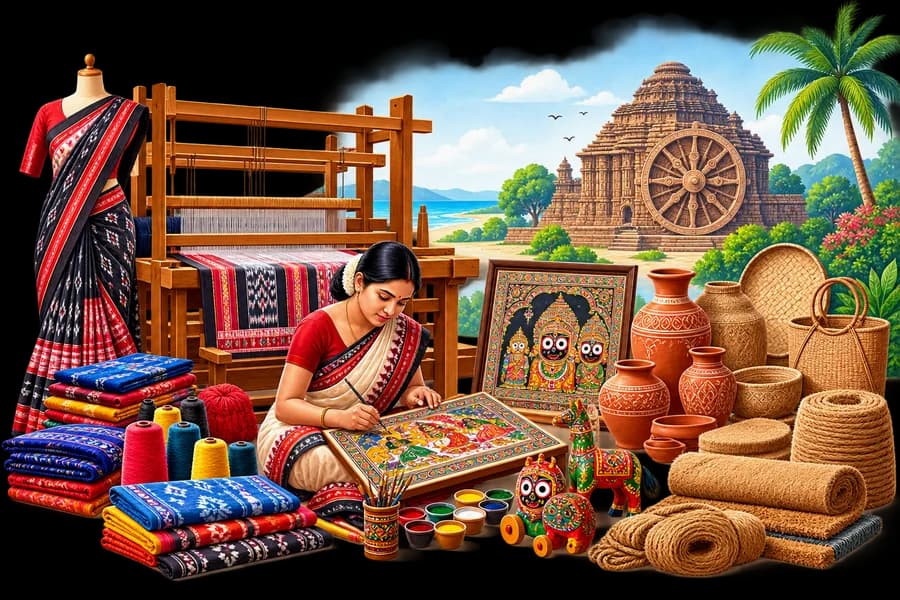
Odisha's handicraft and handloom base is large and geographically concentrated, not a niche: the state's own figures put 65,353 registered handloom weavers and 153 primary weavers' cooperative societies in just three western-Odisha districts — Bargarh, Balangir and Subarnapur — and that's before counting the handicraft clusters (silver filigree, appliqué, stone and wood carving, pattachitra painting) run by a separate department. IPR 2022 names "Handicraft, Handloom & Coir based products" as one of its 13 Priority Sectors. The catch, worked through below, is that Priority-sector status doesn't automatically mean the best subsidy rate at the scale most of these units actually operate at.
Handicrafts and Handloom isn't in our instant self-service catalogue yet — tell us your project basics and we'll prepare it as an Assisted DPR instead, usually within 3 working days.
Start your requestApplicable subsidy route
Named a Priority Sector under IPR 2022 (20% Capital Investment Subsidy, uncapped) — but for a genuinely small handicraft or handloom unit, the general MSME Development Policy 2022's straight 25% general / 30% reserved-category rate usually pays more, since the project is nowhere near the cap where IPR 2022's uncapped feature starts to matter. See the worked example below before assuming the Priority-sector route wins.
Negative-list position
Not on the negative list as a class. Odisha runs separate handloom- and handicraft-specific schemes (Deen Dayal Hathkargha Protsahan Yojana, the Workshop-cum-Godown / Karmashala scheme, weaver credit cards) alongside the general MSME/IPR routes above — worth checking directly with the Handlooms, Textiles & Handicrafts Department for a project that could also draw on those.
What counts as handicrafts and handloom
Handloom weaving (Ikat / Bandha)
The largest sub-segment by registered-weaver count, concentrated in Bargarh, Balangir, Subarnapur and Sonepur. Sambalpuri Bandha (ikat) is Odisha's best-known GI-tagged textile.
Appliqué work (Pipili)
Puri district's Pipili appliqué — umbrellas, wall hangings, lampshades — is GI-tagged and sold through state emporia (Utkalika) as well as export.
Pattachitra & palm-leaf engraving
Centred on Raghurajpur heritage crafts village near Puri. Painting on cloth/palm-leaf is low-capital and skill-intensive — the DPR's cost of project is almost entirely working capital and training, not machinery.
Silver filigree (Tarakasi)
Cuttack's silver-wire filigree work. A goldsmith/silverworking trade — relevant because this is one of the few handicraft trades PM Vishwakarma actually covers (see the licensing note below).
Stone & wood carving
Khondalite stone carving around Puri/Konark. Sculptor/stone-carver is also a PM Vishwakarma-covered trade, unlike weaving.
Dhokra / bell-metal casting
Lost-wax brass and bell-metal casting (clusters around Sadeibareni and similar villages). Small-batch, foundry-based — check OSPCB categorisation before assuming it's licence-free.
Licenses and registrations you'll need
Udyam / MSME registration
Free, lifetime-valid, and the basis for every subsidy claim below — the same starting point as any other sector on this site.
Artisan Card (Development Commissioner, Handicrafts)
A craftsperson first registers on the NITI Aayog portal, then applies for empanelment with the Office of the Development Commissioner (Handicrafts), Ministry of Textiles — the resulting Artisan ID Card is the standard proof of craft practised and unlocks scheme access, exhibition space and marketing support. This is separate from, and in addition to, Udyam registration.
GI authorised-user registration (optional, but valuable)
Sambalpuri Bandha, Pipili appliqué and Konark stone carving are all Geographical Indication (GI) tagged. Making the product doesn't require GI registration, but legally using the protected name/logo in marketing does — that requires registering as an authorised user with the GI Registry. Worth doing before a client leans on the GI name commercially, not a day-one compliance requirement.
PM Vishwakarma registration — only for specific trades
PM Vishwakarma covers exactly 18 named trades, and handloom weaving is not one of them. Several allied Odisha crafts are covered, though: goldsmith (relevant to silver filigree), sculptor/stone carver, potter, and basket/mat/broom maker. Confirm the client's specific trade against the 18-trade list before promising this scheme — a common, avoidable mistake is assuming it covers all artisans generally.
Entity not registered yet? See business registration and how DIC approval works.
Typical machinery and investment
Rough, indicative ranges for a small-to-medium unit — every project's actual cost depends on capacity, automation level and supplier quotations.
| Activity | Investment range | Key machinery |
|---|---|---|
| Handloom weaving unit (single artisan) | ₹15,000 – ₹40,000 per loom (industry estimate, not a government figure) | Pit, frame or table loom depending on product and budget; a semi-automatic loom costs materially more |
| Handloom cluster unit (5–50 looms) | ₹5 lakh – ₹25 lakh (indicative, scales with loom count) | Multiple looms, warping and sizing equipment, dyeing vessels, a common workshed |
| Silver filigree / metal craft workshop | ₹3 lakh – ₹15 lakh (indicative) | Furnace/kiln, wire-drawing bench, hand tools — low mechanisation, skill-dependent |
| Pattachitra / palm-leaf / appliqué work | ₹1 lakh – ₹5 lakh (indicative) | Minimal — brushes, natural pigments/dyes, cloth or palm-leaf stock, hand tools; cost of project is mostly working capital |
A worked example: why the "Priority sector" route isn't automatically best here
Take a 10-loom Sambalpuri weaving cluster with ₹8 lakh of plant & machinery (looms, warping/dyeing equipment). Under IPR 2022's Priority-sector rate, that earns a 20% Capital Investment Subsidy — ₹1.6 lakh, uncapped. Under the general MSME Development Policy 2022, the same ₹8 lakh earns 25% (general category) or 30% (reserved category) — ₹2 lakh or ₹2.4 lakh — because the project is nowhere near the MSME Policy's own ₹2–2.5cr subsidy cap or its ₹10cr plant-and-machinery ceiling, the two limits that make IPR 2022's uncapped status actually matter. At this scale, the MSME Policy route pays 25–50% more. IPR 2022 only overtakes it once plant & machinery investment climbs well past the MSME Policy's caps — rare for a single handicraft or handloom unit, more relevant for a large multi-cluster project. Use our eligibility checker with your own numbers before assuming either route.
Frequently asked questions
Does PM Vishwakarma cover handloom weavers?+
No — weaving is not among PM Vishwakarma's 18 named trades. Several allied Odisha crafts are covered, though: goldsmiths (relevant to Cuttack's silver filigree), sculptors/stone carvers, potters, and basket/mat makers. Confirm the exact trade before promising this scheme to a weaving client.
Is IPR 2022's Priority Sector status always the best subsidy route for a handicraft unit?+
Not necessarily. IPR 2022 gives Priority Sectors a 20% Capital Investment Subsidy with no upper cap, but the general MSME Development Policy 2022 pays 25% (general) or 30% (reserved category) — capped at ₹2–2.5 crore of subsidy and ₹10 crore of plant & machinery. Most single handicraft or handloom units are far below those caps, so the MSME Policy's higher percentage usually wins. IPR 2022 only pulls ahead once a project is large enough to bump against the MSME Policy's ceiling.
Do I need to register as an artisan to get subsidy support?+
For the general CIS routes (MSME Policy / IPR 2022), Udyam registration is what's actually required. A separate Artisan Card from the Development Commissioner (Handicrafts) — via NITI Aayog registration, then DC(H) empanelment — is worth having alongside it, since it's what unlocks scheme access, exhibition space and marketing support specific to craftspersons, not a substitute for Udyam.
Can I call my product "Sambalpuri" or "Pipili" without any extra registration?+
You can make and sell the product without it, but legally marketing it under the protected GI name or logo requires registering as an authorised user with the GI Registry. It's a marketing/legal step, not a manufacturing prerequisite — worth doing once the business is established, not necessarily on day one.
How much capital does a small handloom or handicraft unit actually need?+
Very little compared to a manufacturing unit. A single loom runs roughly ₹15,000–40,000 (industry estimate), so a small 5–10 loom cluster is typically ₹5–10 lakh of plant & machinery. Crafts like pattachitra painting or palm-leaf engraving need even less — often under ₹5 lakh total, since the cost of project is mostly working capital and training rather than equipment.
Sources: Handlooms, Textiles & Handicrafts Department, Government of Odisha — handloom.odisha.gov.in, crafts.odisha.gov.in · Invest Odisha — IPR 2022 Priority Sector list, investodisha.gov.in · Industrial Policy Resolution 2022, Odisha (full text) — industries.odisha.gov.in · Development Commissioner (Handicrafts), Ministry of Textiles — Artisan registration process, handicrafts.gov.in · PM Vishwakarma — 18-trade list, pmvishwakarma.gov.in / IBEF scheme summary · News coverage of Western Odisha weaver/cooperative support figures, OMMCOM News (2025) · Loom investment range: industry estimate (Franchise India), not an independently verified government figure — confirm against a specific supplier quotation for a real DPR
Get an indicative subsidy figure for a project in this sector, checked against the negative list and Odisha's district classification.
Check eligibility