
Spices
₹5 lakh – ₹80 lakh (typical, by scale)
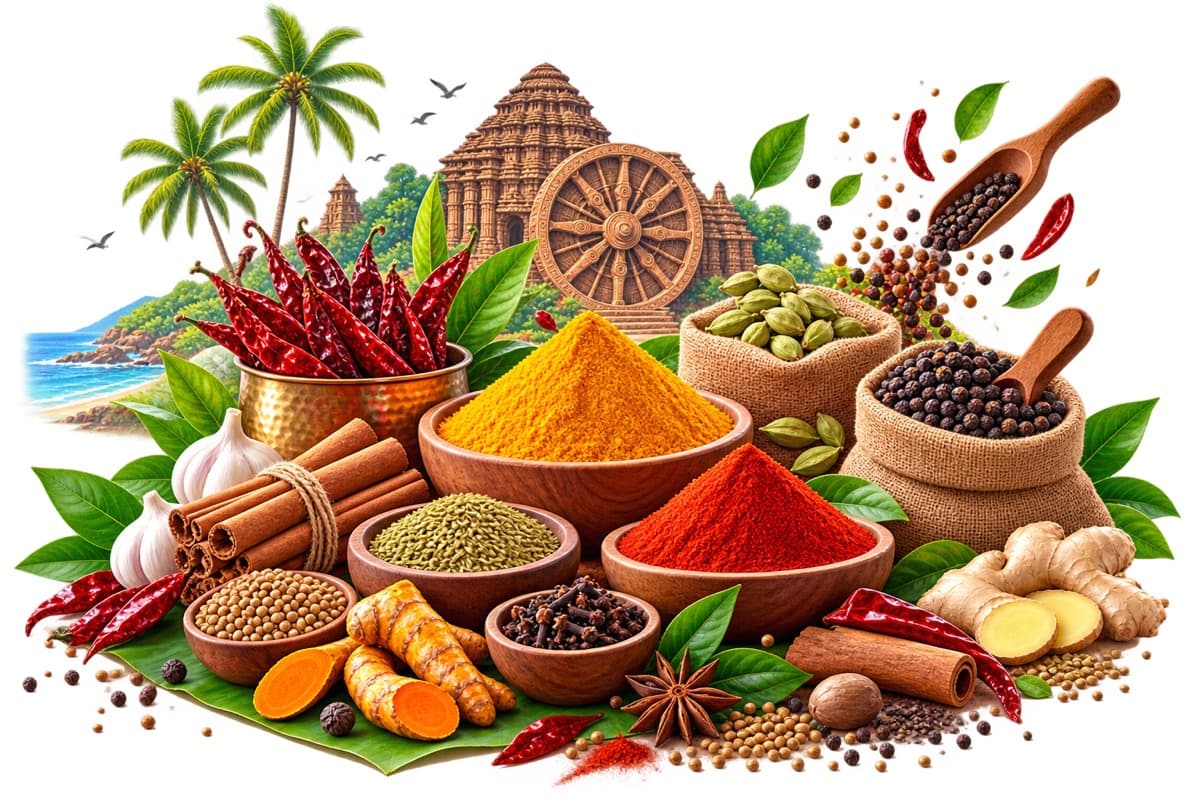
Odisha's spice story has a genuine, GI-tag-backed anchor: Kandhamal Haldi (turmeric), grown by over 60,000 Kondh tribal families across 13,000 hectares, earned its Geographical Indication tag in 2019 and is Kandhamal district's designated ODOP (One District One Product) under PMFME — and India's second-largest turmeric-producing area. That combination — a GI tag plus an ST-majority grower base plus ODOP status — unlocks a stack of scheme benefits most spice DPRs never even check for, particularly the central Spices Board's export-oriented SPICED scheme, whose grant rate for SC/ST applicants and registered farmer groups is meaningfully higher than the standard rate. This page focuses on turmeric as the leading case, since it's Odisha's best-documented spice cluster, but the same subsidy stack applies to chilli, ginger and coriander processing.
Spices isn't in our instant self-service catalogue yet — tell us your project basics and we'll prepare it as an Assisted DPR instead, usually within 3 working days.
Start your requestApplicable subsidy route
Spice cleaning, grading and grinding is not on the negative list and qualifies under the Food Processing Policy 2022. A second, spice-specific lever most DPRs never mention: the central Spices Board's SPICED scheme grant for primary processing infrastructure — higher for ST-community and farmer-producer applicants, which matters directly for Kandhamal turmeric.
Negative-list position
Not excluded, and sits in the lighter Green pollution category at any scale.
What counts as spices
Cleaning, grading & polishing
The lightest-touch, lowest-capital activity — separating good produce from foreign matter and grading by size/quality before sale or further processing.
Grinding & powder production
Turmeric, chilli and coriander powder — the most common value-add, with a large jump in shelf-stability and price realisation over selling raw/whole spice.
Boiling & curing (turmeric-specific)
Traditional turmeric processing needs a boiling step before drying — a process improvement point where mechanised boiler-based units (over open-fire boiling) attract cleaner, more consistent quality grading.
Oleoresin & essential oil extraction
A materially higher-value, higher-capital activity (solvent extraction plant) producing concentrated spice extracts for the food and pharma industry — a different investment scale from grinding/powder units.
Export-grade packing & CRES-linked processing
Packing to Spices Board export-quality standards, under a Certificate of Registration as Exporter of Spices (CRES) — the specific registration that unlocks the SPICED scheme's processing-infrastructure grant described below.
Licenses and registrations you'll need
Udyam / MSME registration
Free and lifetime-valid, and the basis for claiming the Food Processing Policy 2022 subsidy alongside PAN and GSTIN.
FSSAI registration or license
Same 2026 turnover thresholds as other food processing: Basic registration up to ₹1.5cr turnover, State license ₹1.5cr–₹50cr, Central above ₹50cr.
Certificate of Registration as Exporter of Spices (CRES)
Issued by the Spices Board — mandatory for any unit that wants to export spices, and the specific registration needed to access the SPICED scheme's processing-infrastructure grant covered in the worked example below. Not needed for a purely domestic-market unit, but worth obtaining even for a small unit that may export later, since scheme eligibility is tied to holding it.
AGMARK grading (optional)
A recognised quality mark for graded spices — not mandatory to operate, but valuable for retail credibility and often expected by larger institutional buyers.
GI-tag usage authorisation (Kandhamal turmeric only)
Using the 'Kandhamal Haldi' GI name commercially requires authorisation as a registered user under the GI registration (typically routed through the registered proprietor body, e.g. KASAM) — a separate step from FSSAI/Udyam registration, and easy to overlook.
Entity not registered yet? See business registration and how DIC approval works.
Typical machinery and investment
Rough, indicative ranges for a small-to-medium unit — every project's actual cost depends on capacity, automation level and supplier quotations.
| Activity | Investment range | Key machinery |
|---|---|---|
| Small-scale spice grinding & powder unit | ₹5 lakh – ₹18 lakh (indicative, by capacity) | Cleaning/destoner, pulveriser/grinder, sieving unit, packing machine |
| Turmeric boiling, curing & polishing unit | ₹12 lakh – ₹40 lakh (indicative) | Steam boiler, curing tanks/trays, mechanical polisher, drying yard or dryer |
| Oleoresin / essential oil extraction plant | ₹60 lakh – ₹80 lakh + (indicative — the top of this sector's typical cost band, and beyond it for larger plants) | Solvent extraction unit, distillation column, solvent recovery system, effluent treatment |
A worked example: the SPICED scheme's higher rate for ST-community and farmer-group applicants
A general spice exporter's primary processing facility (cleaning, boiling, drying, grading equipment) is eligible for a Spices Board SPICED-scheme grant of 33% of project cost, capped at ₹50 lakh. But the rate is materially higher for two categories that describe much of Kandhamal's actual turmeric-grower base: a Farmers' Group or Farmer Producer Company holding a valid CRES gets 50% (same ₹50 lakh cap), and an SC/ST exporter, or a farmers' group/FPC that is SC/ST-majority, holding a valid CRES gets 75%, capped at ₹112.5 lakh. Since Kandhamal turmeric is grown almost entirely by the Kondh tribal community, a processing venture organised as a farmer producer company of Kondh growers — for example, on the model of KASAM, the existing Kandhamal turmeric marketing society — is a realistic candidate for the 75% central grant on its primary processing infrastructure. This is separate from, and stacks with, the state's own Food Processing Policy 2022 capital subsidy on the same project's plant & machinery — though a bank/DIC would need to confirm the two aren't both claimed against the identical cost head, since 'no double subsidy on the same expenditure line' is a standard condition across schemes.
Frequently asked questions
What subsidy applies to a spice processing unit in Odisha?+
The state's Food Processing Policy 2022 Capital Investment Subsidy applies to spice cleaning, grading and grinding, the same as other food processing. Separately, if the unit registers as a spice exporter (CRES) with the Spices Board, it can also access the central SPICED scheme's grant for primary processing infrastructure — a different, spice-specific scheme most general food-processing DPRs don't check for.
What is the SPICED scheme, and does it apply to a small domestic-market unit?+
SPICED (Sustainability in Spice Sector through Progressive, Innovative and Collaborative Interventions for Export Development) is the Spices Board's current scheme, running through FY2025-26 with a ₹422.30 crore outlay, funding processing infrastructure, quality upgradation and export development. Its processing-infrastructure grant requires a CRES (spice exporter registration), so it's aimed at units that export, or plan to — a purely domestic-market unit with no export intent wouldn't qualify under this specific scheme, though it would still be eligible for the general state subsidy.
Does the SPICED grant rate differ for tribal or farmer-group applicants?+
Yes, materially. The standard rate is 33% of processing-facility cost (cap ₹50 lakh). Farmers' groups or Farmer Producer Companies with a valid CRES get 50% (same cap). SC/ST exporters, or SC/ST-majority farmers' groups/FPCs with a valid CRES, get 75%, capped at ₹112.5 lakh — directly relevant to a Kandhamal turmeric venture organised around the Kondh tribal grower base.
Do I need Spices Board registration to use the Kandhamal Haldi GI tag?+
Using the GI name commercially requires becoming a registered user under the GI registration, typically routed through the registered proprietor body — a separate step from Udyam/FSSAI registration and from Spices Board's own CRES. We could not independently confirm the exact current registered-user process; a promoter wanting to market under the GI name should check directly with the GI registry or KASAM (the existing Kandhamal turmeric marketing society).
What pollution clearance does a spice unit need?+
Spice cleaning, grading and grinding sits in OSPCB's Green category at any scale — the lightest compliance tier, unlike solvent-based oleoresin extraction, which is a materially different, higher-scrutiny activity.
Sources: GI Registry — Kandhamal Haldi (Turmeric) geographical indication, 2019 · PMFME ODOP list — Ministry of Food Processing Industries, Kandhamal district (Spices/Turmeric), pmfme.mofpi.gov.in · Spices Board of India — SPICED scheme (Sustainability in Spice Sector through Progressive, Innovative and Collaborative Interventions for Export Development), FY2022-23 to FY2025-26, indianspices.com · PIB press release, Spices Board scheme for spices export and productivity · Odisha Food Processing Policy 2022, msme.odisha.gov.in · KASAM (Kandhamal Apex Spices Association for Marketing) — public reporting on Kandhamal turmeric processing and marketing
Get an indicative subsidy figure for a project in this sector, checked against the negative list and Odisha's district classification.
Check eligibility