
Textiles and Apparel
₹50 lakh + (typical)
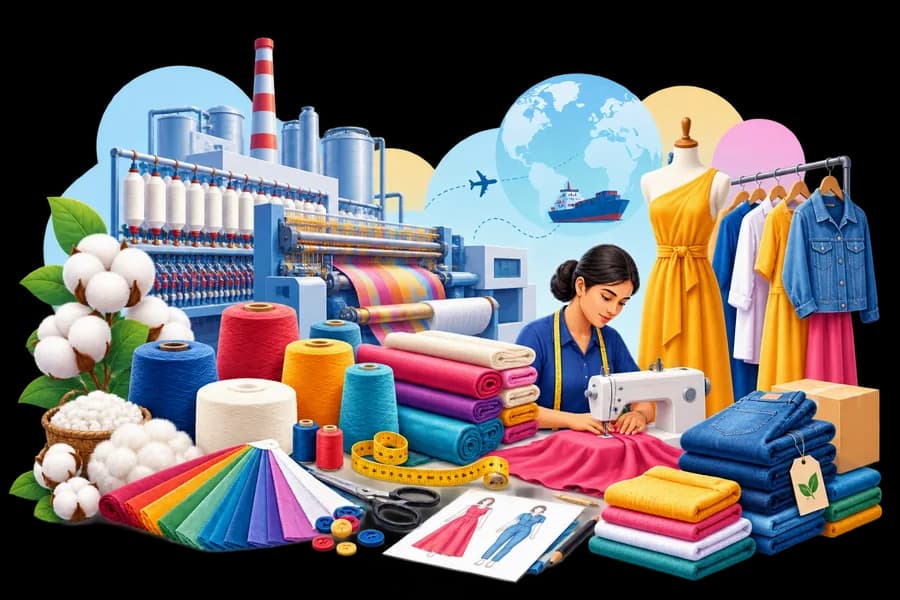
Textiles and apparel is one of the few sectors in this matrix with its own dedicated state policy rather than relying on the general MSME or IPR frameworks: the Odisha Apparel and Technical Textiles Policy 2022 offers a 40% Capital Investment Subsidy on plant & machinery, capped at ₹50 crore — the richest CIS rate on this site for a manufacturing activity. The reason it doesn't automatically apply to every garment DPR that comes through the door is a genuine eligibility gate, not fine print: a minimum of 200 workers, 90% of them Odisha-domicile. That's a real factory, not a small stitching unit — worth checking before quoting this policy to a client.
Textiles and Apparel isn't in our instant self-service catalogue yet — tell us your project basics and we'll prepare it as an Assisted DPR instead, usually within 3 working days.
Start your requestApplicable subsidy route
A dedicated Odisha Apparel & Technical Textiles Policy 2022 offers 40% Capital Investment Subsidy on plant & machinery, capped at ₹50 crore — well above the general MSME Policy (25–30%) or IPR 2022's Thrust-sector rate (30%, uncapped). The catch: it requires a minimum of 200 workers, 90% Odisha-domicile. Most single small-to-medium units won't clear that bar and default to the general MSME Policy or IPR 2022 Thrust-sector route instead — see the worked example below.
Negative-list position
Plain tailoring is excluded, but readymade garment manufacture is a named exception — the distinction matters and should be confirmed with the client's actual activity description.
What counts as textiles and apparel
Readymade garment manufacturing
The named exception to the plain-tailoring exclusion on the negative list — confirm the activity is described as garment manufacture, not tailoring/stitching services, before assuming eligibility.
Technical textiles
Geotextiles, medical textiles, industrial and protective fabrics — explicitly covered by the same Apparel & Technical Textiles Policy 2022 as garments, not a separate scheme.
Home textiles
Bed linen, curtains, upholstery fabric and similar furnishing textiles — same policy coverage as garments.
Knitting and hosiery
A distinct process from woven-garment manufacture (different machinery — knitting machines rather than sewing lines) but the same subsidy policy applies.
Plain tailoring / stitching services
Excluded on the negative list — this is the line the "readymade garment manufacture" exception exists to distinguish from.
Licenses and registrations you'll need
Udyam / MSME registration
Free, lifetime-valid, and the basis for the general MSME Policy / IPR 2022 route if the dedicated Apparel Policy's worker-count threshold isn't met.
Factory licence (Factories Act 1948)
A garment unit crosses the 10-workers-with-power threshold quickly given how labour-intensive stitching lines are — almost any unit beyond a handful of machines will need this from the Directorate of Factories & Boilers, same process as other manufacturing sectors on this site.
Pollution control consent (OSPCB)
Plain cutting, stitching and finishing is a dry process, typically Green or White category. Adding an in-house dyeing, printing or washing line changes that materially — wet-processing textile units are generally a higher pollution category. Confirm the specific process mix with OSPCB before assuming the lighter category.
Entity not registered yet? See business registration and how DIC approval works.
Typical machinery and investment
Rough, indicative ranges for a small-to-medium unit — every project's actual cost depends on capacity, automation level and supplier quotations.
| Activity | Investment range | Key machinery |
|---|---|---|
| Micro garment unit (5 machines) | ₹5 lakh – ₹8 lakh (industry estimate, not a government figure) | Single-needle lock-stitch machines, one overlock/serger, a cutting table, pressing equipment |
| Small garment unit (10–15 machines, 300–500 pieces/day) | ₹12 lakh – ₹20 lakh (industry estimate) | Multiple lock-stitch and overlock machines, a proper cutting section (straight or band-knife), pressing/finishing station |
| Policy-scale unit (200+ workers, technical-textile or export-grade) | ₹8 crore + (indicative — the scale where the 40% dedicated policy actually applies) | Industrial sewing lines, automated cutting systems, knitting/weaving machinery as relevant, in-house finishing |
A worked example: why most garment units don't get the 40% rate
A 50-worker garment unit with ₹1 crore of plant & machinery doesn't meet the Apparel Policy's 200-worker minimum, so it routes to the general MSME Development Policy 2022 instead — 25% (general) or 30% (reserved category), giving ₹25 lakh or ₹30 lakh. Scale the same business up to a 250-worker export-oriented unit with ₹8 crore of plant & machinery, and it clears the threshold: the dedicated Apparel & Technical Textiles Policy 2022 pays 40% — ₹3.2 crore — on top of a monthly employment-cost incentive (₹5,000/male, ₹6,000/female worker, Aadhaar-linked, for 60 months) that the general MSME route doesn't offer at all. The policy exists for factory-scale employment generation, not small units — size the DPR honestly before promising the 40% figure.
Frequently asked questions
Does every garment or apparel business in Odisha get a 40% subsidy?+
No — that 40% rate belongs to the dedicated Apparel and Technical Textiles Policy 2022, which requires a minimum of 200 workers (90% Odisha-domicile). A smaller unit doesn't qualify and instead uses the general MSME Development Policy 2022 (25–30%) or, above a large enough plant & machinery investment, IPR 2022's Thrust-sector rate (30%, uncapped).
What if my garment unit has fewer than 200 workers?+
You're not eligible for the dedicated Apparel Policy's 40% Capital Investment Subsidy. Route the DPR through the general MSME Development Policy 2022 instead — 25% general / 30% reserved category, capped at ₹2–2.5 crore of subsidy and ₹10 crore of plant & machinery.
Is a tailoring shop eligible for textile-sector subsidy?+
No — plain tailoring/stitching services are on the negative list. The exception is readymade garment manufacturing, which is a genuinely different activity classification. Make sure the client's actual business is described as manufacturing, not a tailoring service, before assuming eligibility.
What employment incentive does the Apparel Policy offer beyond the capital subsidy?+
A monthly employment-cost incentive for 60 months after commercial production starts — ₹5,000 per male worker and ₹6,000 per female worker, paid Aadhaar-linked. This only applies to units that clear the same 200-worker threshold as the capital subsidy; it isn't available to smaller units on the general MSME route.
How much does a small garment manufacturing unit cost to set up?+
Based on industry estimates rather than a government model: a micro unit with 5 sewing machines runs roughly ₹5–8 lakh, and a small unit with 10–15 machines producing 300–500 pieces a day runs ₹12–20 lakh, largely driven by machine count and working capital for fabric and trims.
Sources: Odisha Apparel and Technical Textiles Policy 2022 — Invest Odisha, investodisha.gov.in · Odisha MSME Development Policy 2022, msme.odisha.gov.in · Odisha Industrial Policy Resolution (IPR) 2022, industries.odisha.gov.in · Garment unit machinery/investment estimates — industry sources (Online Clothing Study, Kladana, Gartex India); not independently verified against a government model project report
Get an indicative subsidy figure for a project in this sector, checked against the negative list and Odisha's district classification.
Check eligibility